Charging an Electric Car at Home: Levels, Costs and What an Electrician Will Ask
Most electric car charging happens overnight in a driveway. Here is what the two home charging levels deliver, and what installing the faster one involves.

- A normal household outlet adds roughly 3 to 5 miles of range per hour. A 240-volt charger adds roughly 20 to 40.
- Many drivers with short commutes never need more than the ordinary outlet.
- Installation cost depends mostly on the distance from your electrical panel and whether the panel has spare capacity.
The petrol station habit is hard to shake. New electric car owners often worry about where they will charge, picturing a search for public plugs. In practice, most charging happens at home, overnight, while the car would be parked anyway.
Home charging comes in two speeds. Understanding the gap between them, and whether you need the faster one, saves both money and anxiety.
Level 1: the ordinary outlet
Every electric car can charge from a standard 120-volt household outlet using the cable supplied with the car or bought separately. This is called Level 1.
It is slow. Expect roughly three to five miles of range for each hour plugged in. Over a twelve-hour night that is around 40 to 50 miles, which covers more daily driving than people expect.
Level 1 needs no installation at all, provided the outlet is in good condition and on a circuit that is not shared with other heavy loads.
Level 2: the 240-volt charger
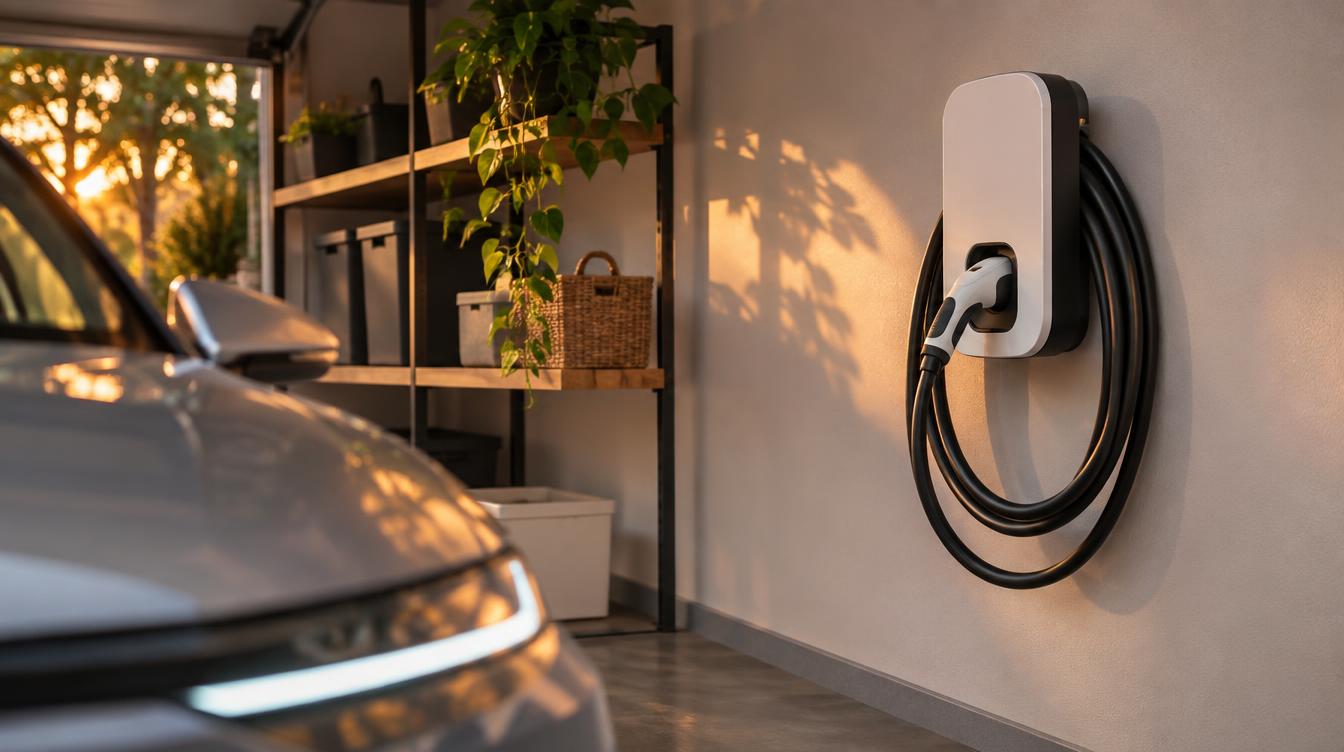
Level 2 uses a 240-volt circuit, the same kind that supplies an electric dryer or oven. It delivers power several times faster.
Depending on the circuit and the car, Level 2 typically adds 20 to 40 miles of range per hour. Almost any electric car will refill from low to full overnight.
Which one do you need?
Start with your daily mileage. If you usually drive under 40 miles and can plug in every night, Level 1 may be all you need, at least to begin with.
Level 2 earns its cost if you drive further, have a large battery, share one charger between two cars or want to take advantage of cheap overnight electricity in a short window.
Buy the car first, live with the ordinary outlet for a month, then decide. Many owners find they never needed the upgrade.
What an electrician will ask
A Level 2 installation is mostly a question about your electrical panel. An electrician will want to know three things.
- Capacity: whether your panel has enough spare capacity for a new 240-volt circuit.
- Distance: how far the charger will be from the panel, since cable and labour are the main costs.
- Location: whether the charger will be indoors or outdoors, and where the car's charging port sits when parked.
They will carry out a load calculation, which adds up the home's existing electrical demand. If there is not enough headroom, the options are a panel upgrade, a lower-powered charger or a load management device that pauses charging when other large appliances run.
Circuit sizes in plain terms
Chargers are described by the current they deliver, in amps. Electrical codes require a continuous load to use no more than 80 percent of the circuit's rating.
| Circuit breaker | Charger setting | Approximate power | Good for |
|---|---|---|---|
| 30 amp | 24 amp | 5.8 kW | Plug-in hybrids, modest daily mileage |
| 40 amp | 32 amp | 7.7 kW | Most drivers |
| 50 amp | 40 amp | 9.6 kW | Larger batteries |
| 60 amp | 48 amp | 11.5 kW | Maximum home speed for many cars |
A higher setting is only useful if the car can accept it. Each car has an onboard charger with its own limit, and some top out at 7 or 8 kilowatts however powerful the wall unit is.
Plug-in or hardwired
Some chargers plug into a 240-volt outlet and others are wired directly to the circuit. Plug-in units are easy to replace or take with you when you move. Hardwired units can deliver higher power and have one less connection to wear.
For outdoor installations, hardwiring is generally preferred. Either way, the work should be done by a licensed electrician, with a permit where required.
What it costs
The charging unit commonly costs a few hundred dollars. Installation is where prices spread out: a short run beside the panel may cost a few hundred dollars, and a long run or a panel upgrade can take the total to a couple of thousand or more.
Utilities and state programmes often offer rebates for the charger, the installation or both. Check what is available before you buy, since some require pre-approval.
Smart features worth having
A connected charger lets you schedule charging, track energy use and sometimes share power between two cars. Scheduling is the most useful of these, though many cars can do it themselves.
If you have solar panels, some chargers can be set to use surplus solar output, which is worth asking about.
Connectors
Home chargers in North America use one of two plug shapes. Adapters between them are widely available, and many newer cars and chargers support both. Check which connector your car uses before you order.
Running costs
To estimate cost per mile, divide your electricity rate by the car's efficiency. A car that travels three and a half miles per kilowatt-hour, charged at 15 cents per kilowatt-hour, costs a little over four cents a mile.
Your own rate may be higher or lower, so use the figure on your bill. In most regions home charging is noticeably cheaper per mile than petrol, and much cheaper than public fast charging.
The sensible order
Check your daily mileage, try the ordinary outlet, and call an electrician only if you find yourself short. If you do install Level 2, size it to the car you have and the panel you have rather than the largest number on the box.
Then plug in when you get home and forget about it. That is the part petrol never offered.
Frequently asked questions
Do I need a Level 2 charger at home?
Not always. If you drive under about 40 miles on a typical day and can plug in every night, an ordinary 120-volt outlet may be enough. A Level 2 charger becomes worthwhile with longer daily mileage, a larger battery or more than one electric car.
How much does it cost to install a home EV charger?
The charging unit itself commonly costs a few hundred dollars. Installation varies widely, from a few hundred dollars for a simple run beside the panel to a couple of thousand or more if the panel needs upgrading or the cable run is long. Get at least two quotes.
Can I install a home charger myself?
A 240-volt circuit should be installed by a licensed electrician, and most areas require a permit and inspection. Plugging a portable charger into an existing, correctly rated outlet is something owners do themselves.