Certified Pre-Owned, Explained: What the Badge Covers and What It Does Not
A certified used car costs more than an ordinary one. Whether the premium is worth paying depends on who did the certifying and what the warranty actually says.

- Manufacturer certification and dealer certification are different products. Only the first is backed by the carmaker.
- The value is in the warranty. Read its start date, its length and its deductible before comparing prices.
- A certified car still deserves a vehicle history report and, ideally, an independent inspection.
Somewhere between a new car and an ordinary used one sits the certified pre-owned car. It has been inspected, it comes with extra warranty cover and it costs more, often by a thousand dollars or more compared with a similar car without the badge.
For many buyers that premium is money well spent. For others it buys very little. The difference lies in the details of the programme, and those details are easy to check once you know where to look.
What certified actually means
A certified pre-owned car is a used vehicle that has passed an inspection and been sold with a warranty beyond whatever remains of the original one. That is the whole idea. Everything else is a matter of who stands behind it.
There are two very different kinds of certification, and dealers do not always volunteer which one you are looking at.
Manufacturer certified
These programmes are run by the carmaker. The car must be below a certain age and mileage, commonly under five or six years old and within a mileage cap, and it must pass a checklist the manufacturer publishes.
The warranty is backed by the manufacturer and honoured at any franchised dealer for that brand, anywhere in the country. Programmes often add roadside assistance and sometimes a loan car during repairs.
Dealer certified
Any dealer can inspect a car and call it certified. The term is not protected. The inspection standard is whatever the dealer decides, and the cover is usually a service contract from a third-party company.
Some dealer programmes are perfectly good. Many are thin. The only way to tell is to read the contract, which you should ask for before you discuss price.
| Question | Manufacturer certified | Dealer certified |
|---|---|---|
| Who backs the warranty | The carmaker | The dealer or a third party |
| Where it is honoured | Any franchised dealer of the brand | Often that dealer only, or approved shops |
| Inspection standard | Published by the manufacturer | Set by the dealer |
| Eligibility limits | Fixed age and mileage caps | Whatever the dealer chooses |
Certified is a word. A warranty is a document. Ask for the document.
Reading the warranty
Three details decide how much the cover is worth. The first is the start date. Many programmes measure their term from the date the car was first sold new, not from the day you buy it. Seven years of cover on a four-year-old car is three years of cover.
The second is what is included. Powertrain cover protects the engine, transmission and driven wheels. Comprehensive cover, sometimes called bumper to bumper, is broader and usually much shorter.
The third is the deductible. Some programmes charge nothing per repair visit and others charge a fee each time. Over several years the difference adds up.
- Ask for the warranty start date and end date in writing.
- Ask which components are excluded, not only which are included.
- Ask whether the cover transfers to the next owner, which helps resale.
- Ask whether repairs must be done at that dealer.
What the inspection does and does not prove
Certification checklists commonly run to a hundred points or more. They cover fluids, brakes, tires, lights, electronics and a road test, and worn items are supposed to be replaced.
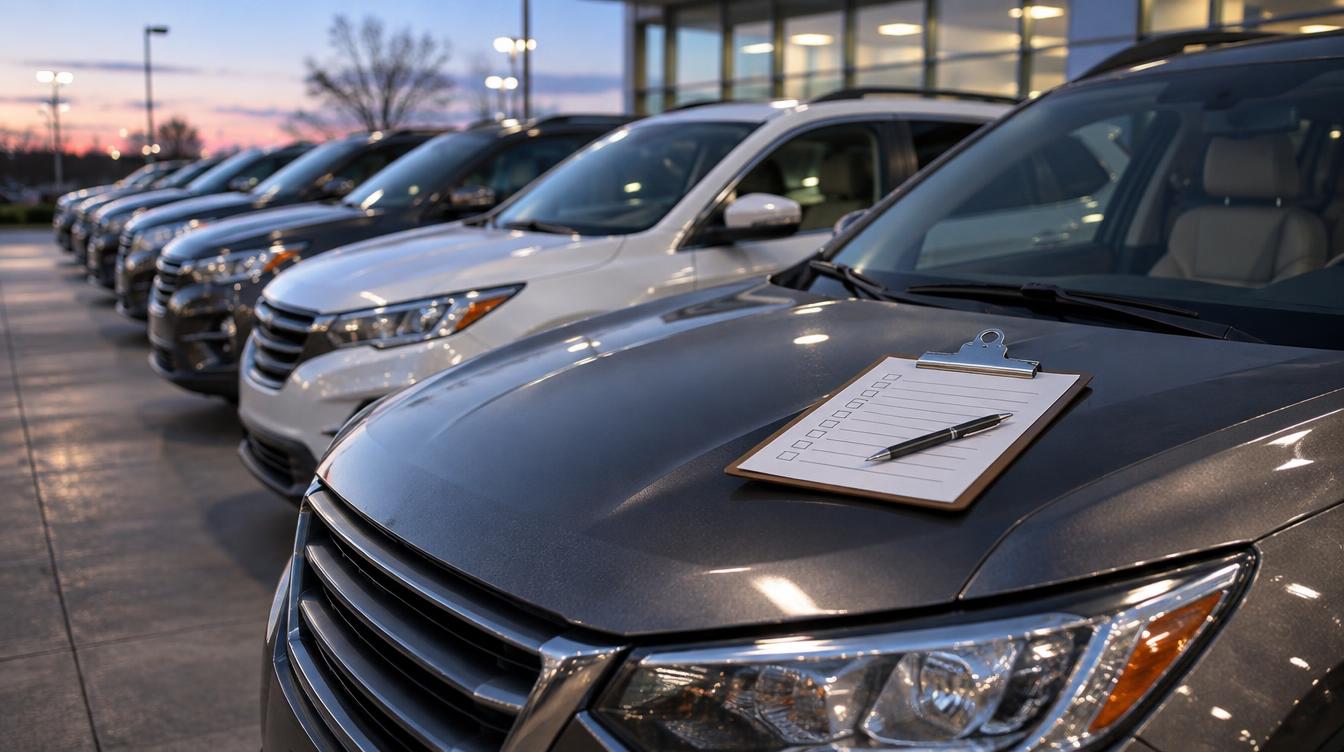
The inspection is carried out by the seller. That is not a criticism, simply a fact worth remembering. Ask for a copy of the completed checklist for the specific car, with the technician's notes, and check that the tires and brake pads were actually measured rather than ticked.
Still check the history
A certified car should come with a vehicle history report at no charge. Read it for accident records, the number of previous owners, and whether the car was a rental or fleet vehicle.
None of those is automatically a reason to walk away. They are reasons to look more closely and, sometimes, to ask for a lower price.
Is the premium worth it?
Work it out per year. Take the price difference between the certified car and a similar ordinary one, and divide it by the years of additional cover you would really receive.
If that figure is modest and you intend to keep the car beyond the original warranty, the certified car is good value. If the car has plenty of factory warranty left anyway, you may be paying for cover that overlaps what you already have.
Consider the model's reputation too. Extra cover is worth more on a complicated vehicle with expensive parts than on a simple one known for running for decades.
Where certified cars make the most sense
They suit buyers who want a late-model car, intend to keep it for five years or more, and value predictable costs over the lowest possible price.
They suit less well the buyer who changes cars every two or three years, since much of the cover will go unused, or the buyer comfortable arranging an inspection and taking a little more risk in exchange for a lower price.
At the dealership
Ask one question first: is this certified by the manufacturer? If the answer is anything other than a clear yes, treat the car as an ordinary used car with a service contract attached, and price it accordingly.
Then ask for the checklist, the history report and the warranty booklet. A good certified car arrives with all three, and a seller who produces them without hesitation has already told you something useful.
Frequently asked questions
Is a certified pre-owned car worth the extra money?
It can be, when the certification comes from the manufacturer and adds meaningful warranty cover to a car you plan to keep for several years. If the added cover is short, or the car is already known for reliability, an ordinary used example with an independent inspection may be better value.
What is the difference between manufacturer certified and dealer certified?
Manufacturer programmes follow a published standard, are honoured at any franchised dealer of that brand and are backed by the carmaker. Dealer certification is the individual dealer's own promise, sometimes backed by a third-party service contract, and its quality varies widely.
Can I negotiate the price of a certified pre-owned car?
Yes. The certification adds cost for the dealer, so there is usually less room than on an ordinary used car, but the price is still negotiable. Compare the out-the-door price with similar non-certified cars to see what you are paying for the badge.