All-Season, All-Weather or Winter? A Tire Guide for Real Roads
Tires are the only part of a car that touches the road. Choosing the right type, and reading the sidewall, matters more than most options on the order form.

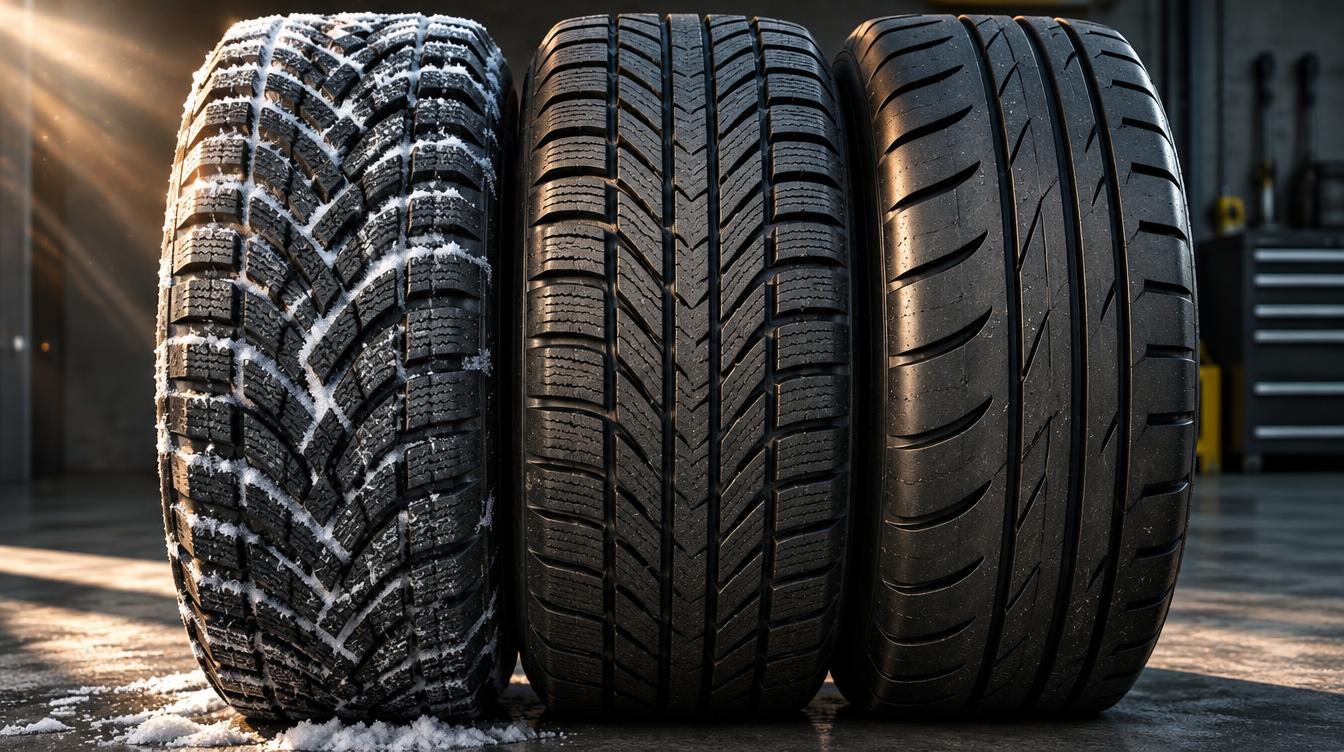
- All-season tires are a compromise built for mild climates. They harden and lose grip in real cold.
- All-weather tires carry the three-peak mountain snowflake symbol and can stay on all year in moderate winters.
- Check tread depth, pressure and the tire's age. Tires can be too old even when the tread looks fine.
It is easy to spend weeks choosing a car and thirty seconds choosing its tires. Yet every instruction you give the car, to turn, to stop, to pull away, passes through four patches of rubber each about the size of your hand.
The right tire for your climate can shorten a stopping distance by car lengths. The wrong one can make a capable car feel nervous. Here is how to tell them apart.
The four main types
Summer tires use a firm compound that grips superbly on warm dry and wet roads. They lose grip quickly in cold weather and should not be used in snow.
All-season tires are what most new cars are sold with. They are designed to be acceptable in most conditions and excellent in none, and they suit mild climates well.
All-weather tires are a newer category. They are true year-round tires that meet a recognised standard for snow traction.
Winter tires use a soft compound that stays flexible in the cold, with deep tread and thousands of small cuts that bite into snow and ice.
| Type | Best for | Weakness | Stays on all year? |
|---|---|---|---|
| Summer | Warm climates, sharp handling | Unsafe in cold and snow | Only where it never freezes |
| All-season | Mild climates, long tread life | Limited snow grip, hardens in cold | Yes, in mild regions |
| All-weather | Moderate winters, one-set convenience | Wears a little faster | Yes |
| Winter | Regular snow and ice | Wears fast and feels soft in warmth | No, swap in spring |
Why temperature matters
Rubber changes with temperature. Below roughly 45 degrees Fahrenheit, the compound in summer and many all-season tires begins to stiffen, and grip falls away even on a dry road.
Winter compounds are formulated to stay pliable in the cold. That is why a winter tire outperforms an all-season tire on a cold, dry morning, not only in snow.
The symbol to look for
Many all-season tires carry the letters M+S, for mud and snow. This marking is based on tread geometry alone and involves no performance test.
The three-peak mountain snowflake symbol is different. A tire carrying it has passed a standard snow traction test. All winter tires and all-weather tires have it. If you want one set of tires for a region with real winters, this symbol is what to look for.
All-wheel drive helps you go. Tires help you stop. Only one of those prevents a collision.
Reading the sidewall
The string of characters on the side of a tire looks cryptic and is easy to decode. Take 225/65R17 102H as an example.
- 225 is the width of the tire in millimetres.
- 65 is the height of the sidewall as a percentage of the width.
- R17 means radial construction, for a 17-inch wheel.
- 102 is the load index, a code for how much weight the tire can carry.
- H is the speed rating.
Replacement tires should match the size and meet or exceed the load index and speed rating listed on the placard inside the driver's door.
How old is the tire?
Every tire carries a date code: four digits at the end of the DOT number. The first two are the week and the last two the year, so 2324 means the 23rd week of 2024.
Rubber ages even when unused. Many manufacturers recommend replacing tires somewhere between six and ten years old, whatever the tread depth. Check the date on tires sold as new, too.
Tread depth
New tires usually start with around 10/32 of an inch of tread. The legal minimum in most states is 2/32, marked by small bars in the grooves that become flush with the tread when it is worn out.
Wet grip declines well before that point. Many safety groups suggest replacing at about 4/32 of an inch. A simple gauge costs a few dollars and removes the guesswork.
Treadwear ratings
Most tires sold in the United States carry a treadwear grade, such as 400 or 600. A higher number suggests longer life, though the tests are run by each manufacturer and comparisons between brands are approximate.
Longer-lasting compounds are harder, which generally means a little less grip. For most drivers a mid-range grade is a sensible balance.
One set or two?
In regions with long, snowy winters, two sets, summer or all-season plus winter, give the best safety. Each set wears only half the year, so the total cost over time is lower than it first appears.
In regions with occasional snow, all-weather tires are an excellent single-set answer. In warm regions, a good all-season tire is all most drivers need.
Looking after them
Rotate tires at the interval in your owner's manual, commonly every 5,000 to 7,500 miles, so they wear evenly. Have the alignment checked if the car pulls to one side or the tread is wearing more on one edge.
Replace tires in sets of four where you can. If you replace only two, most tire makers advise fitting the new pair to the rear axle for stability in the wet.
Buying
Compare the installed price, including fitting, balancing, valves and disposal of the old tires. Check the date codes before they go on the car, and keep the paperwork for the treadwear warranty.
Good tires are not exciting. They are simply the cheapest way to make any car safer, quieter and better to drive.
Frequently asked questions
What is the difference between all-season and all-weather tires?
All-season tires are designed for dry and wet roads in mild temperatures and offer only limited snow performance. All-weather tires use a compound and tread that pass a standard snow traction test, shown by the three-peak mountain snowflake symbol, while still being suitable for summer use.
When should tires be replaced?
Replace tires when tread depth reaches 2/32 of an inch, the legal minimum in most US states. Many safety organisations suggest replacing sooner, at around 4/32 of an inch, because wet braking distances grow as tread wears. Tires should also be inspected for age, and many manufacturers recommend replacement after six to ten years regardless of tread.
Do I need four winter tires or just two?
Four. Fitting winter tires to only one axle creates a large difference in grip between the front and rear of the car, which can make it unstable when braking or cornering.